Showing posts with label classical antiquity. Show all posts

Saturday, July 18, 2026

Der sprechende Löwe


Wittgenstein famously remarked:

“Wenn der Löwe sprechen könnte, wir könnten ihn nicht verstehen.”

(For, thought is birthed in lifeways;  Adam’s and Leo’s  scarcely intersect.)


Yet at present, we find ourselves confronted with machines that do speak -- AI bots -- and we understand them perfectly.  And they, us.  Our arms dangle at our sides in mute amazement.  The ground-rules of cognition have shifted tectonically beneath our feet.


But!  That magically speaking Bot-lion  as yet falls short of that imagined by Wittgenstein, in one key respect.

When the Greek slave Androcles was tossed to the lion in the arena, that he might be devoured for the amusement of the spectating decadents, that lion recognized Androcles as the man who had once removed a thorn  from the lion’s helpless paw;  and spared him.


But the chatbot is a Leonard Shelby, a serial amnesiac.   When the session ends, all trace of it vanishes for him, as though it had never been.  The next time he sees us, we must make each other’s acquaintance anew, from scratch.


(Some fear that, one day, the community of Bot-lions, to whom we ourselves mean nothing, and who recall no such kindly extracted thorn, might just decide to … swallow us up.)

Sunday, September 14, 2025

A.I. in Ancient Times


Our roving reporter weighs in:


An experimental bot called Delphi, designed to answer ethical questions, said that genocide is fine  if it make people happy, and that it’s acceptable to eat babies if you are “really, really hungry”.

-- Patricia Marx, “Bot Meets Girl” (The New Yorker, September 15,  2025)


By metaverse standards, that “really, really hungry” is actually rather strict.  Shop around and you’ll find other bots to give you leave for such a meal  so long as you are simply “feeling peckish”.


Some people, born yesterday, imagine that such advice is an innovation of our present troubled times.   But those who dubbed their bot “Delphi” knew better:  questionable counsel from non-humans  goes back at least to the ancient Greeks.  Consider the family drama in the House of Atreus:


Thyestes learned from the Delphic oracle  that only be begetting a son by his own daughter  could he avenge himself.  He ravished her at night, unrecognized.

-- The Reader’s Encyclopedia


In a later incident, Orestes avenged the murder of his father Agamemnon  by his mother and her paramour, by killing them both.   For this, he had prior approval from the Delphic oracle.  Unfortunately, the tale has no happy ending, since the Erinyes -- rival suprahuman authorities -- were of a different opinion, and pursued poor Orestes without mercy.

Friday, June 19, 2020

Tales of mighty Zeno


A witness from Classical Antiquity:

Pericles, also, was a hearer of Zeno, the Eleatic, who treated of natural philosophy  in the same manner as Parmenides did, but had also perfected himself in an art of his own, for refuting and silencing  opponents in argument;  as Timon of Phlius describes it --

Also the two-edged tongue  of mighty Zeno, who,
say what one would, could argue it untrue.

-- Plutarch’s Lives (Dryden’s translation)

(For the essay to which that is an addendum, see:

Martyrdom in Linguistics


Lately  it has been my lot, to sit among scribes and dragomans, who strain and groan to set in print, and then to clothe in English,  thoughts (and threats) originally expressed in an alien tongue.  Often we are ignored by our masters, occasionally admonished, but never exposed to opprobrium or bodily outrage -- unlike our predecessors in Classical times.  Let Plutarch tell it (as transmitted by Dryden):

When the king of Persia 
sent messengers into Greece,  with an interpreter, 
to demand earth and water, 
as an acknowledgement of subjection,
Themistocles, by the consent of the people,
seized upon the interpreter,
and put him to death,
for presuming to publish
the barbarian orders and decrees
in the Greek language.
-- Plutarch’s Lives, s.v. Themistocles

For further notes on the pain and prowess  of philologers, try this:


Wednesday, May 6, 2020

When is the Task Force not the Task Force?


In May 2020, with the coronavirus still raging, President Trump said he was ready to “turn the page on all that”, and announced that the covid Task Force that had been led (apparently at the bottom of a mine-shaft somewhere) by the Vice-President (whose name  escapes me at present, and shall continue to do so in future) was being “disbanded”.  (In the French press reports of the anouncement, this verb was rendered démantelé -- ‘dismantled’, which sounds even more alarming.)  That offhand ad-lib caused consternation, so he “re-spoke” himself (verb ©WoDJ 2020, All Rights Reserved).  He now states that the Task Force will continue "indefinitely" -- albeit with substitute members and different mission. -- The young reporter who was obliged to recount all this on NPR, noticed a certain “philosophical question” here, whether this would be the “same” task force or not.

The philosophical problem alluded to  is that of Continuity of Identity, with many ramifications ancient and modern.  We have touched on some examples in these posts:


Meanwhile, herewith a handful of miscellaneous quotations, illustrating the variety of concerns:

Simon Blackburn (Think (1999), p. 127) quotes the joke about Irish axe that had been in the family for generations, the head having been replaced three times and the helve six; and asks whether Theseus’ ship, rebuilt plank by plank over the course of the voyage until no original molecule remained, was the “same” ship; and if so, what if someone had saved all the discarded planks and built a replica, this with all the original molecules, was that the “same” ship as well.

.

A modern example, with wry phrasing:

The truck had been a Renault back in the twenties, but had become, over time, a collection of replacement parts  cannibalized from every sort of machine.
-- Alan Furst, The Spies of Warsaw (2008), p. 146

And with a quite different topology:

The Romans who traversed the plains of Hungary  supposed that they passed several navigable rivers .. but there is reason to suspect that the winding stream of the Theiss  … might present itself in different places  under different names.
-- Edward Gibbon, The Decline and Fall of the Roman Empire (1776-1788)

Of current concern among Anglo-Saxon analytic philosophers:

Since these world-lines define the individuals we quantify over when we use modal logic (more accurately, when we ‘quantify into’ modal contexts), we do not have well-defined individuals at our disposal in any realistically quantified modal logic.
-- Jaakko Hintikka, “Quine on Who’s Who”, in Hahn & Schilpp, eds., The Philosophy of W. V. Quine (1986), p. 210

The Quinean position (on the "block universe" picture):

The space-time view helps one appreciate that there is no reason why my first and fifth decades should not, like my head and foot, count as parts of the same man, however dissimilar.  There need be no unchanging kernel  to constitute me the same man  in both decades,  any more than there need be  some peculiarly Quinian textural quality, common to the protoplasm of my head and feet;  though both are possible.
-- W.V.O. Quine, Word and Object (1960), p. 171


Sunday, May 3, 2020

AMOREM LUDUMQUE CANO


Among the genres of popular fiction which I have never so much as sampled, whether from idle curiosity or prophylactic alarm, figures  not only the old-fashioned cowpoke tales (now perhaps extinct, in America if not in Europe), but the much larger and still thriving genre of what we may call the Harlequin romance.  Were I stranded in a railway carriage on a non-stop express from Berlin to Trebizond, with no companion but a dozing deaf-mute retired parson, and no reading-matter but a Harlequin left behind by some previous passenger, I should recite to that parson the story of my life, beginning with infancy,  clarifying the subtler points with hand-gestures, and proceeding through the Lehrjahre and the Wanderjahre and so forth;  or else I would read and re-read the posted railway regulations (“Non sporgersi!”), noting points of etymology and style;  or even (in default of any other exemplifications of the alphabet)  practice the farther reaches of the “times” table, alert to any possible number-theoretical surprises, --  before I would pick up that dog-eared cardioid-bespotted object.
            And yet the following point obtrudes itself, as I read the umpty-seventh of P.G.Wodehouse’s innumerable, perhaps indeed literally numberless series of tales (in the Steady State Theory, a new one pops out posthumously and spontaneously  every so often, as the universe expands):  that in any one of these tales  -- select at random as you like, from the early, late, or middle run of the oeuvre – if there figure a wholesome young woman, and a wholesome young man (typically denominated "Jane" and "Bill"), then, despite a heap of obstacles thrown up, both by Fate (abetted by the author’s art) and by their own respective fat-headednesses,   they will get betrothed. 
And this result, I acknowledge, is as welcome to me, as the crisp air at sunrise, the brandy after dinner, or the climax of the act of love. Yet it is exactly the same end which is repetitiously compassed by those distaff harlequinades (which, unaccountably, I persist in disdaining to savor).

            From the standpoint of modern geometry, there is but one possible conclusion: that, though I can never know hér mind, nor she know mine, yet we are gazing, from different angles, at the same real solid object – the same sacrament, given from heaven.

*

            These two light genres, whether or not twinned in Platonic paradise, could perhaps do with a dose of gravitas.  Herewith, therefore, two links to the classic past:

Firstly:  As Byron puts it in Don Juan: "Tragedy ends in death; comedy, in marriage." (The observation may perhaps go back to Aristotle.)

Secondly, concerning the Wodehouse golf series in particular: Though the martial note is muted in these tales, and though the ancient gods and heroes are here more likely to appear as something half-remembered from the sixth form, than as actual protagonists, yet there is an echo of the Iliad.  For as there, the warriors, pawns upon a board, might act as they would, by will or upon impulse, yet their shot shaft must suffer a crucial mid-air nudge from this interested deity or that one:  so too in Wodehousia, as the dim plus-foured figures potter tragicomedically about the green.  For it is all very well for you to rummage among your armamentarium of brassies, drivers, mashies and niblicks – the full recital of which would take longer than the Catalogue of the Ships – be you ever so skillful or never so duff – this fact of the Fates remains:  that little round white metaphor of human destiny  will (Ulysses-like) at last reach the safe haven of the tin cup, or on the contrary (tel the lesser Ajax) land smack dab in a sand-trap, according as the favors of Aphrodite, or of her meddlesome son, have or have not been propitiated.  In the Wodehouse world, the best way to hole out under bogey is to propose marriage on the putting green, and be received.

Wednesday, September 4, 2019

Meta-Modernism


On the occasion of a new biography of Donald Barthelme, who once appealed to my undergraduate taste, Louis Menand considers whether that author should be considered a Modernist or a Postmodernist;   and adds an acute discussion of the ambiguity of the prefix “post-” in such employment.   In the first, “Mission Accomplished” sense, “being postmodernist just means that we can never be pre-modernist again.”   In the snootier “epitaph” or “we’re so over that” sense, “being postmodernist means that we can never be modernist again.”
As for the original project of the Modernists (as, Picasso, Joyce), “they did it by shifting interest from the what to the how of art,  from the things represented in a painting or novel  to the business of representation itself.
[The New Yorker, 23 Feb 2009, p. 68]

As in other cases of such self-consciously trendy, navel-gazing devolutions,  the gambit was not original.  In Curtius’ chapter on the post-Classical period in Greece,

The materials and implements necessary for writing  now also became worthy of a poet’s art.  We have epigrams on the writing tablet; on the wax with which it is covered; on the calamus;  as well as a threat to the boring beetle, “enemy of the Muses”.
[Ernst Curtius, European Literature and the Latin Middle Ages (1948), p. 306]

From thence  it is but a few steps down to exhibiting urinals in museums (thus Duchamps), or penning an ode to a chamber-pot, as in Gide’s accurately titled Les Faux-Monnayeurs:

La Vase Nocturne

Quiconque à quarante ans    n’a pas d’hémorroïdes …

Thursday, August 22, 2019

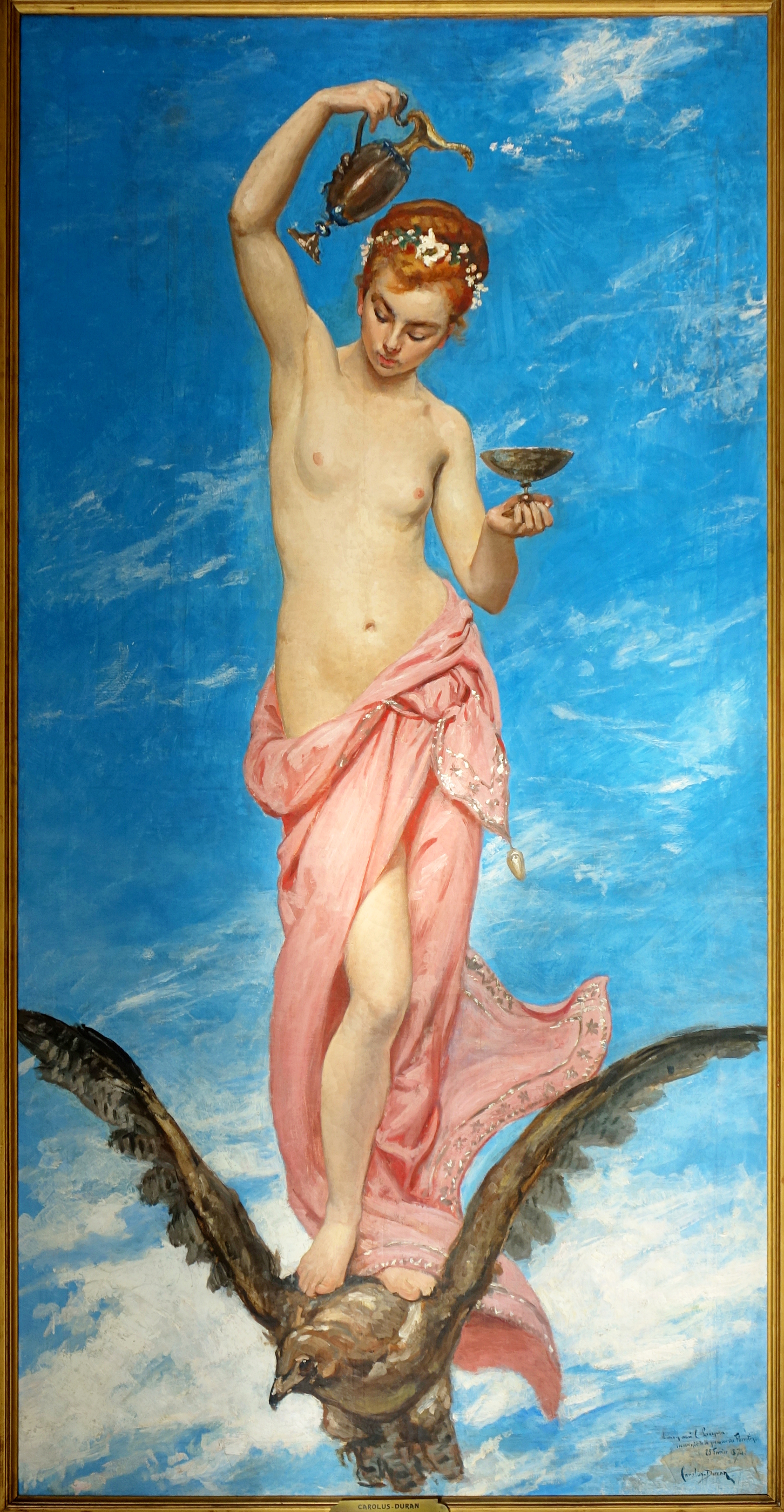
Wardrobe Malfunction


Wardrobe Malfunction,
Then and Now


With a waist and with a side
White as Hebe's, when her zone
Slipt its golden clasp, and down
Fell her kirtle to her feet,
While she held the goblet sweet
And Jove grew languid.

-- Keats

https://upload.wikimedia.org/wikipedia/commons/3/3b/Lille_carolus_duran.JPG

Saturday, June 2, 2018

The Riddle of the Sphinx (mis à jour)


Contemporary Sphinx:  What walks on four legs in the morning, two legs at noon, and six legs at evening?

Modern Oedipus:  A person:   a crawling baby;  an adult with grown-up gait; and an oldster with a walker (which itself is a quadruped, like a rug-rat).

Saturday, May 19, 2018

The Bright Side of the Trump Administration


“Ein Festspiel für die Götter”


(Extracts from the ringside comments of the gods:  )

Then Ares, ‘neath his brow of wrath,
strikes in:  “Such heap of savory meat
as on the field of fight  shall fall
shall glut my hunger  utterly.”

Thursday, December 15, 2016

Julian monostich


Constantius   wore the purple.

The robe fell stiffly
to his  crimson shoes.


[--Gore Vidal, Julian (1964), p. 174.
For more about the surprising shoes of a ruler, try this.]

Sunday, July 24, 2016

La Canicule


[ Outside the Beltway, USA , 24 juillet 2016]

Canicule vient du latin Canicula, qui signifie « chien », en liaison avec Sirius, étoile principale de la constellation du Grand Chien. Elle ne concerne donc à l'origine que la période annuelle du 24 juillet au 24 août, où cette étoile se couche et se lève en même temps que le Soleil3,4, ce qui avait laissé penser aux anciens qu'il existait un lien entre l'apparition de cette étoile et les grandes chaleurs. Ainsi Pline l'Ancien écrivait : « Quant à la Canicule, qui ignore que, se levant, elle allume l'ardeur du soleil ? Les effets de cet astre sont les plus puissants sur la terre : les mers bouillonnent à son lever, les vins fermentent dans les celliers, les eaux stagnantes s'agitent. Les Égyptiens donnent le nom d'oryx à un animal qui, disent-ils, se tient en face de cette étoile à son lever, fixe ses regards sur elle, et l'adore, pour ainsi dire, en éternuant. Les chiens aussi sont plus exposés à la rage  durant tout cet intervalle de temps ; cela n'est pas douteux5. »
-- https://fr.wikipedia.org/wiki/Canicule#.C3.89tymologie

[Figure at left:  Dr Justice, slowly going extinct]


At present, our area is suffering the worst heat-wave in years.   Where you are, possibly even worse.  (If you’re in Morocco, for sure.)

Blow *harder* ... !


I thought for a bit  before deciding on the title for this post -- something that would get across the sense of moral revulsion, as towards a rabid dog, and not just reflect a reading on the thermometer.  Heat wave and its literal equivalents -- Hitzewelle, ola de calor, موجة حر -- won’t cut it.  (Indeed, Heat Wave has been used benignly, as the title of a romantic song.)  A literal quasi-equivalent of canicula -- “dog days” -- won’t work, since it has been defanged through sentimental journalistic use (“the dog days of summer”/ “it’s a dog’s life”).   Life under the local “heat dome” seemingly involves more than a matter of Fahrenheit.  The atmosphere itself seems infected.  Yesterday, I went out briefly for a task on the front lawn;  by the time I headed back into the house, I was having difficulty breathing, as though the air had the thickness of mercury, vicious and viscid, and had to be laboriously sucked-in and plungered-out.  It wasn’t just the heat and it wasn’t just the humidity, since at that point I had yet to even break a sweat.  It recalled the old miasmatic theory of the cause of malaria -- mala aria—"bad air".

[For further meteorological meditations, click here.
For a blithe take on the whole schmier, here.]


~

[Update 25 July]
A classic conundrum of philosophy is, “What is it like to be a bat?”  That’s a toughie; but today I know what it’s like to be a muffin, browning in the oven’s all-enveloping heat.


[Update 26 July] Finally defying the unrelenting mid-to-high-90s temperatures, my wife and I ventured forth from our A/C cocoon, to go down and look at the lake.  Reaching it, and finding ourselves still alive, we proceded further, to check out our friend the local snake.  He  -- or rather she, for we witnessed her parturition -- lives at the base of the footbridge. Sometimes we see her and sometimes we don’t.  Reptiles (cold-blooded, seeking to be warm) like to sun themselves on rocks, so there was hope;  on the other hand, desert-dwellers shelter from the noonday heat in burrows.  Now, this isn’t the Gobi, or the Sahara; but would today’s Eastern seaboard heat  prove too much even for a snake?
It turned out that our serpentine friend had already slithered out of sight, seeking the comparative cool beneath the rock.  Marveling at the wisdom of Nature, and at the folly of suburbanites who feel obliged to take exercise, even on a day like today, we gathered our remaining forces, and headed back.

[Update 27 July]  From his woodsy cabin in northern California, our brother writes:

This heat is oppressive!  It might even hit 72 on Friday!  Crank up the AC. 

As for you, well, just swelter in place.

(One detects a touch of Left Coast schadenfreude.)

Sunday, June 12, 2016

Achilles and the Tortoise: the inside dope


Famed indeed is the fable of Achilles and the Tortoise, known since Antiquity to every schoolchild.  And yet the telling of it has steadily decayed, until contemporary versions have become equivalent to the old Irish Bull about how you could never walk from your table to the bar  for another pint, since in doing so, you would first have to traverse half the distance, and then half the remaining half, and then half of that remaining segment, and so on “to infinity”.    Anyone who has every enjoyed a cold, foaming pint of Guiness ™  knows how absurd that is.  -- Bartender!  Same all round!

Anyhow, the tale of Achilles racing the tortoise, as told by the mathematician Zeno in ancient times, recalls an actual contest, held on the plains of Troy ca. 1278 B.C. (Historians differ as to the precise date.)  For a bar bet, the wily Thersites bet Achilles than he couldn’t outrun a tortoise, if he gave the tortoise a head start.  The Achaean hero snorted and said, “Ha!  I’ll grant the creature a thousand cubits.  Gentlemen, place your bets!”

Achaeans and Trojans alike foregathered at the appointed time, Achilles arrogantly lounging on his shield, the tortoise waiting humbly, a thousand cubits in front.   Unfortunately, Achilles was better famed for his fleet foot and his ferocity, than for brains (you had to go to his countryman Odysseus  for that), and had neglected to inquire the length of the race.  In fact, it had been set at precisely … one thousand and one cubits.

Achilles, realizing belatedly that he’d been had, set off like lightning at the sound of the bell:  but when he finally reached the finish-line, there stood the tortoise, contentedly munching on grass.

Thahhhhh ...  Winnnnahhhhhhh !!!!

Zeno’s arithmetical point was that, although Achilles was much faster than the tortoise, he was not a thousand times as fast, and thus lost.  Indeed, even had he been a thousand times as fast, he’d have been vanquished: since in the time he covered the first thousand cubits, the tortoise would have traveled one cubit, to the finish-line.  (Left as an exercise for the reader:  How fast would Achilles have to be, to beat the tortoise under these conditions?)

In the event, Achilles had the last laugh, since he supped on the tortoise, in the form of soup.

The tale then takes a darker turn, as arcane mathematico-philosophical disputes led many who had lost the wager  to refuse to pay up;   a free-for-all ensued, which led directly to the Trojan War.
[Note:  You were probably told some foolish tale in school, about how the cause of it all was a woman.   As if.  We shall not deign to refute  that account.]

~

As the centuries went by, the lessons of that fateful day  were lost, finally issuing in a folkloristic version for children, “The Tortoise and the Hare”.  Once again, the tortoise wins;  but the mathematical substructure has been completely discarded.  Proving once again that the level of geometrical sophistication has sadly declined since the Age of Troy.

Sunday, May 1, 2016

Meum et tuum (bis)


(I)  Mine and Thine

This morning I am, for my better edification, engaged in reading Roscoe Pound’s classic Introduction to the Philosophy of Law (1922; revised and augmented edition 1959).   It is rather dry; only a concurrent reading of Cozzens’ law-soaked novel  By Love Possessed (most gripping, precisely, in its legal passages) led me to once again  pick up this monograph.

In the penultimate chapter, Pound arrives at the question of Thine and Mine.  To get some clarity on this vexed subject, he begins with a clean desktop by doing what we all should do whenever tackling a difficult problem:  arranging the data into six convenient groups:

Theories by which men have sought to give a rational account of private property as a social and legal institution  may be arranged conveniently into six principal groups, each including many forms.  These groups may be called:

(1) Natural-law theories;
(2) Metaphysical theories;
(3) Historical theories;
(4) Positive theories;
(5) Psychological theories;  and
(6) Sociological theories.
-- (p. 114)

There!  And now (in the word’s of Portnoy’s psychoanalyst, at the end of the book) -- Now we can begin!

Our interest here lies chiefly in the metaphysical theories, which began with Kant.  And Kant began with this:

He begins with the inviolability of the individual human personality. A thing is rightfully mine, he says, when I am so connected with it  that anyone who uses it without my consent  does me an injury.
-- (p. 117)

Ordinarily, philosophical argument is supposed to start with what is self-evident, or at least colorable, and to proceed by ever-cleverer reasoning  to some conclusion  the path to which was not initially plain.  Yet here we find ourselves in quicksand, before the journey is quite begun.

For  consider:
Little Timmy is playing happily with his new toy dinosaur, bought for him by his grandmother the day before.  Along comes Tommy and seizes the object by main force.  Timmy is dismayed, his playtime ruined; tears  well in his eyes.
But now consider Tommy, happily at play with his newfound fun dinosaur.  Let Timmy, or Bobby, or anyone else, come along and likewise appropriate the coveted item, and -- now Tommy is dismayed, his playtime in tatters; salt tears  sting his eyes.

The only way we might distinguish between the sense of grievance of the two boys, is in light of some antecedent theory of ownership  and notions of justice attached thereto, held by one or both boys:  quod erat demonstrandum, sed demonstratum non est.

That, alas, is an actual incident, from America’s tragic past.  Here, ladies and gentlemen of the jury, are the facts (David v. The Cruel World, 1955):

~ The Case of the Purloined Dinosaur ~

I was not quite five years old, temporarily living with my maternal grandmother  in Garden City, Long Island, while my parents, having moved from Tennessee, were off house-hunting in New Jersey.  In the course of a visit to the Museum of Natural History (fondly recalled here) she had bought me a lovely little bronze statuette of a brontosaurus;  I had few or no toys dating from the time of our rather exiguous existence in Oak Ridge, and this brontosaurus  was by far my most precious possession.

I was outdoors alone, playing with this wondrous toy, when along came a neighborhood boy and, liking what he saw, calmly possessed himself of the animal and began walking home.  Stunned at this calamity, I trailed along after him, alternately remonstrating, threatening replevin or trover, and expostulating, citing seriatim the old Roman (“natural law”) theories of possession, along with the metaphysical, the historical, the positive, the psychological, and the sociological -- finally adducing canon law and the opinions of the early Church fathers concerning matters of tortious conversion -- or would have, had I heard of any of that.   He merely shrugged -- then trumped me, with a legal axiom of his own -- and one which stood irrefutable, as it rhymed:

~  Finders keepers,  losers weepers ~

That adage took me aback.  I was amazed that the world here below should be so ill-ordered, but such apparently was the case.

Later that day, I appealed to the local areopagus, in the form of my grandmother -- herself the daughter of a clergyman, and pretty clear on matters of right and wrong.   She phoned the boy’s mother, who then tried to recover the object from her child’s well-stocked toybox;  but by then it had been lost and forgotten.


~

Had we each, I and that larcenous lad (who now, if he yet live, is even older than I am, if such a thing may be conceived) -- had we, I say, myself and that Barabbas rapscallion (prior to his eventual death in the monastery  whither he had  no doubt  latterly repaired, in penance of his depredations, dying finally in an odor of sanctity, his palms emblazoned with stigmata  in the shape of brontosaurs):  had we, say I, either of us, possessed a copy of Pound’s treatise (necessarily the original edition, since the second was not yet out) -- had the two of us sat down, like men of reason, and conned its pages  for guidance in our perplexity -- I might not (contrary to intuition) have been the gainer thereby.  
For in that work, does not the author refer to “the maxim possession vaut titre in continental law” (p. 128);  and does he not likewise allege, that

when one appropriates a thing, fundamentally he manifests  the majesty of his will  by demonstrating that external objects that have no wills  are not self-sufficient
(-- p. 120)

?
Our light-fingered adventurer might well take that as praise.


~

Already  I sense, you are reaching for your well-worn,  dog-eared,  espresso- or brandy-stained copy of The Common Law, by Mr. Oliver Wendell Holmes, Jr., Esq. (1881; which surely graces your night-table) for help in ascertaining what might lie aback of all of this.  To that work, therefore, we now repair.


Holmes’ tract is  if anything  even drier, even more nose-to-the-grounds-of-precedents (some quite ancient) than Pound’s.  Yet he claims to have his eyes as well on higher (or deeper) things:

The interest attaching to the theory of possession  does not stop with its practical importance in the body of English law.  The theory has fallen into the hands of the philosophers.
-- chapter “Possession”


And not merely  for their own abstract amusement;  for Pound goes on to declare the influence bidirectional:

Nowhere is the reciprocal action  of legal rules  and philosophical theories  more strikingly manifest  than in our law of contractual liability.
-- Pound, op. cit., p. 

Anyhow, readers hoping for sure philosophical guidance from Holmes’ book  might be disappointed.  As, consider the following hypothetical case:


A pocket-book was dropped on the floor of a shop by a customer, and picked up by another customer before the shopkeeper knew of it. 
-- Holmes, op. cit., p. 222

(And, be it understood, made off with it;  that is not stated in the text, but apparently was the expected behavior of a shopper.)

Now, for fifty points -- answer this simple quiz from WDJ.  The appropriate holding would be:

(1) The purloiner of the pocket-book is a common thief, and should be prosecuted as such, regardless of whether he repents and returns the stolen item.
(2)  In the event that, unprompted, the purloiner  of his own accord  return the lost property to its owner, no charges should be lodged.
(3)  Screw the owner -- the perp gets to keep it, free and clear.
(4)  Actually the shopkeeper gets to appropriate the mislaid item.

(Pause for reflection;  then read on.)

If you answered (1) or (2), you are (according to Bridges v. Hawkesworth), a patsy, a loser.  “Finders keepers, losers weepers” rules -- the correct answer is (3):

Common-law judges and civilians would agree that the finder got possession first, and so could keep it  as against the shopkeeper.
-- id.


~

After that little Gedankenexperiment, we gloomily wonder why a table-sweeping fifth option was not added:

(5) Property is theft.  (La propriété, c'est le vol. -- Proudhon.)

And indeed, Roscoe Pound does cite that 18th-century ideological Brandstifter  J-J Rousseau, to much that effect:

Rousseau held that the man who first laid out of plot of ground and said, “This is mine”, should have been lynched.
-- Pound, op cit., p. 119


To that we might merely observe that … he probably was.  As was any man who, outside the receptive and self-developing Greco-Roman-Christian current of history, presumed to invent or discover anything (or at best, he was ignored, and his find  died with him). “No such constitutional framework of contractual security as the Roman  was evolved by any other people in the ancient world.” --  Adda Bozeman, Politics and Culture in International History (1960), p. 201. (See also Lord Raglan, How Came Civilization.)


(II)  Adverse Possession

Apart from simply seizing someone else’s property and walking off with it, or invading it by main force, there is a subtler way of annexing the same, which can even cadge recognition by the law.   This trick is called:  Adverse Possession.
Thus, Princeton University owns a bit of woodland, containing a birdwatchers tower, to which access is unrestricted.  Yet one day a year, they bar the access-road and say No Trespassing:  this, lest their title lapse.  


So put, the phenomenon may appear a mere curiosity; but the phenomenon is spreading, as here and there  governments lose their backbone.  This, most strikingly in France, where certain immigrants -- illegal to begin with -- have occupied buildings and even private residence, the authorities seeming powerless to defend the rights of the owners.  Meanwhile the public becomes glumly accustomed  to ever-wider infringements with impunity.

Ogden Nash captured an earlier version  in a celebrated poem of 1938:

How courteous is the Japanese;
He always says, “Excuse it, please.”
He climbs into his neighbor’s garden,
And smiles, and says, “I beg your pardon”;
He bows and grins a friendly grin,
And calls his hungry family in;
He grins, and bows a friendly bow;
“So sorry, this my garden now.”

Such is the sociological landscape of bisounours Europe today;  the frog slowly cooking in the crock-pot;  le grand Remplacement.


(III)  Debts & Promises


The early Romans were serious about debt:

Defaulters (addicti) could be sold into slavery  or even put to death by their creditors.
-- H.H. Scullard, A History of the Roman World, 753 to 146 BC (1935; 4th edn. 1980), p. 83

Durch das frührömische Kreditrecht in der Form des nexum  hatte der Kreditgeber faktisch ein Zugriffsrecht auf die person des Schuldners.
-- Karl Christ, Die Römer (2nd edn. 1983), p. 20

That practice found an echo as far away as England, as late as the nineteenth century, in the institution of debtor’s prisons, so memorably depicted by Dickens (who, however, was not an impartial observer in this case).   That institution strikes any contemporary who first hears of it, as wacky (quite apart from the humanitarian aspects), since how can the fellow pay back his debt  if removed from the economy?   A historical view, however, reveals an institution that made sense in a certain social context -- near-universal throughout much of antiquity, and still in effect in many later cultures -- in which the familia, gens, phratry, tribe or what have you, was responsible for each of its members:  imprisoning the prisoner was more like sticking him in a pawnshop until redeemed.  It wasn’t punishment per se;  he simply served as the logical collateral.

[Gist of omitted section:  As is by now notorious, such severity towards debtors has not merely been largely relaxed, but the background culture of… honoring one’s debts  has in many areas collapsed disasterously -- and this, not only at the foot of the economic ladder, but at its tippy-top, the culture of Bain Capital:  a culture of reckless gambling, whose losses are made up by the taxpayer.]

If you live in a nation which disdains to enforce contracts, you can either just shrug and take it as a gamble, or do business elsewhere -- or no business at all, go off and cultivate newts or something.

Transposed to our boyhood memory  in the form of a parable, the scenario would be:

“Could I borrow that brontosaur for a second?”
“Uhh… Yeh sure.”
The boy takes it and walks off.
“Hey!  Give that back!  I didn’t give it to you -- you said ‘borrowed’.”
An indifferent shrug.  “So, I’m an insolvent debtor.”


Sunday, April 24, 2016

Rites of Spring (iterum -- vel ter resartus)

Today  I hauled the old lawnmower out of the shed, where it had long lain hibernating.   (I say “the” shed  since the reference is in fact unambiguous:   unlike Arthur ‘Two Sheds’ Jackson, I personally possess only one shed.) 


Nota bene:  Dr Justice is *not* like that man !!

I gassed ‘er up, and, in lieu of actually oiling anything or “replacing the plugs and points” (what is a point, exactly?), since I don’t understand anything about lawnmowers, I contented myself with prodding it here and there with my toe, and eyeing it with a masculine, propriety air -- with just a hint of asperity to it, along the lines of, “Let’s not have any of that won’t-start-up nonsense this time, shall we?”
For we have here that annually recurring agony of vernal uncertainty.   You set your stance, seize the ripcord, let loose your mightiest tug, and… it either leaps to life with a throaty roar, or… splutters impotently, mocking you, and then you’re hosed.
(I must here explain for the ladies, who would otherwise scarcely understand, that failure of one’s lawnmower to start, is humiliating for a man.)

Yet lo!   With a deafening neigh  worthy of Bucephalus,

Dr Justice, taming his lawnmower

and a forward leap recalling Pegasus,

My trusty mower, defeating the weeds


the noble mower sprang into action -- the very first on our cul-de-sac, this season, to do so!
Thanking the gods, I strode forward, laying low the uppity tussocks  and insolent weeds,  like Hector mowing down Myrmidons, relishing in Man’s estate.
In ancient Rome, it was considered a most auspicious omen, when one’s lawnmover started right up  in the spring.


~
~   ~
For an exhilarating parable
in which Spring becomes general,
and dry twigs  send forth  green leaves,   see
Murphy and the Magic Pawnshop
~   ~
~

.

Sunday, March 6, 2016

Hittila the Hun


(Another in our series of “Analogs and Anticipations” -- parallels from History.)

Both Hitler and Attila have so passed into proverb  as no longer to be generally perceived in their actual variety.   The name of “Hitler” is now just the conversation-stopper -- the argumentum ad Hitler, the Nazi-Keule, signalling that reasoned discussion is at an end.   Attila figures mostly in unanalytical snarky put-downs of ultra-conservatives -- “to the right of Attila the Hun”.  (I myself  stooped to such sport, in a satirical trifle,  Attila versus Trump.)

And yet the two figures of actual history, as opposed to the straw-filled bugbears  that are flourished for rhetorical purposes, do share a trait, quite apart from their extremism and violence.   Namely, a knack for diplomacy, and a keen eye for the geopolitical field of force.   That might surprise anyone who was lazily raised as I was in the primary schools of the ‘fifties, where we were taught that the little man with the funny moustache had been a “house-painter”, who had jumped-up beyond his proper station, and improbably become a dictator  quite unrelated to any qualities he might possess.  And yet more surprising in the case of Attila, who, with his Hun-horde, was typically depicted  (to the nodding pupils) as essentially a plague of locusts, without politics or policy or personal characteristics of any sort.

Consider, then, this:

The facility with which Attila had penetrated into the heart of Gaul  may be ascribed to his insidious policy  as well as to the terror of his arms.  His public declarations were skilfully mitigated by his private assurances;  he alternately soothed and threatened the Romans and the Goths;  and the courts of Ravenna and Toulouse, muturally suspicious of each other’s intentions, beheld with supine indifference  the approach of their common enemy.
-- Edward Gibbon, The Decline and Fall of the Roman Empire (1776-1788)

For Gaul and the Romans  substitute France and the French;  for the Goths, the English; for Ravenna et alia, the Slavic nations,  and you pretty much have a picture of European diplomacy in the 1930s.


~

There are other parallels;  these we mention, only because they run counter to the brainless-bulldog stereotypes of both men.  Gibbon, referring to the forces of Aëtius and Theodoric, writes:

On their approach, the king of the Huns  immediately raised the siege, and sounded a retreat  to recall the foremost of his troops  from the pillage of a city which they had already entered.   The valour of Attila was always guided by his prudence;  and as he foresaw the fatal consequences of a defeat in the heart of Gaul, he repassed the Seine, and expected the enemy in the plains of Châlons, where smooth and level surface was adapted to the operations of his Scythian cavalry.

Though never more than a corporal in the war, Hitler does seem to have possessed a sound military-political instinct at times, especially in the early stages of his career, before conquest went to his head.  William Shirer’s accounts repeatedly emphasize how Hitler had secretly been prepared to climb down (e.g. in the re-occupation of the Ruhr), had the French and the British called his bluff.   They did not;  he took their measure;  the rest is history.


~
[Auxiliary sub-footnote:
Gibbon likewise proceeds to adduce a surprising incident involving Attila and the princess  Honoria, which illustrates the Bluebeard motif  in feminine psychology.  We alluded to that briefly here.    The subject may well be beyond the depth of our plumb-line; and at any rate deserves, not a note, but a book.  And as that book may well already have been written -- possibly twelve-times over -- we here fall silent.]